Thursday, October 12, 2017

Global Evidence Summit 2017 – a student perspective

The Global Evidence Summit took place from 13 to 16 September 2017

It was the first meeting of Cochrane, the Campbell Collaboration, the Guidelines International Network (G-I-N), the International Society for Evidence-based Health Care and the Joanna Briggs Institute, and, for our luck, it was our very first time attending a Colloquium. This event took place in the beautiful city of Cape Town, South Africa, the land of the first heart transplant.

For us students, it was necessary to know what type of sessions, short or long, or workshops, we could attend, since the programme mentioned that all of these were aimed at a specific group of attendees. The colloquium is not only for experts in health research or evidence-based medicine, but also offers activities for those who are starting on the road.

We had a series of 5 plenaries in total, starting with the use of evidence on the African continent

This plenary provided examples of how networks influenced evidence-based practice and evidence-based health policies, ending with a thought on how the evidence could achieve a more equitable world for all.

In the plenary “Breaking down the silos: Digital and trustworthy evidence ecosystem”, Greg Ogrinc taught us that the combination of all improves the patients’ results, the system and the development of the professional.

In the session “A dialog with founders: What approaches and activities ensure research achieves its expected impact?”, we reinforced our bases of evidence-based medicine and the steps to assure an impact in the society.

The Students 4 Best Evidence workshop was, without a doubt, one of the most enjoyable because more students like us, and professors dedicated to the teaching of evidence-based medicine, attended. It was very gratifying to see more colleagues interested both in learning and in teaching, as the truth is that us, the new generations, have much to learn and this kind of knowledge should be available to all. In this workshop we had the message that one of the things we can do is to help each other.

Plenary #3: “Evidence for emerging crises” was one of the most moving conferences, with the great video of “Let’s #OutsmartEpidemics” which tells us that an epidemic can start anywhere, reach anyone and end millions of lives, but working together we can #OutsmartEpidemics.

Finally, on the last day of the conference, we presented our poster “Use of Cochrane Evidence in Mexican clinical practice guidelines”, giving our small contribution to this colloquium

It was amazing to see how many people stand for our beautiful language, Spanish. We should remember that everyone learns more in their native language. Related to this, the Cochrane Colloquium of 2019 will be held in Santiago, Chile.

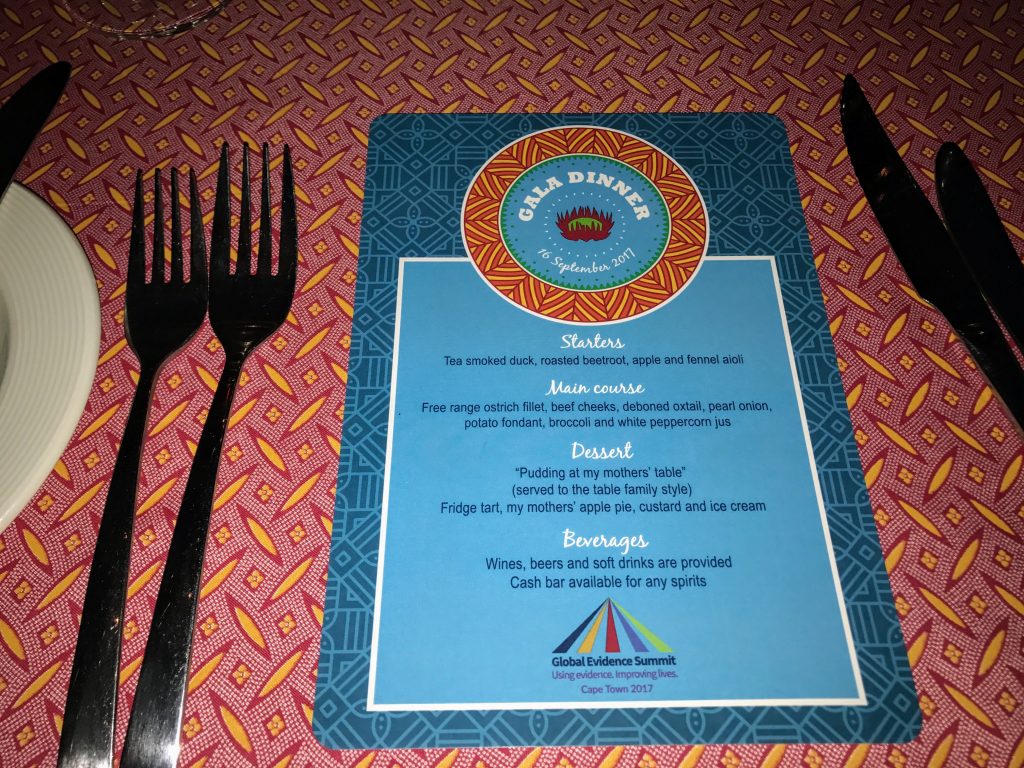
The best farewell was the great “Gala Dinner” with its peculiar menu of duck, cow cheeks, ox tail and ostrich fillet. And, of course, a little dancing never hurts.
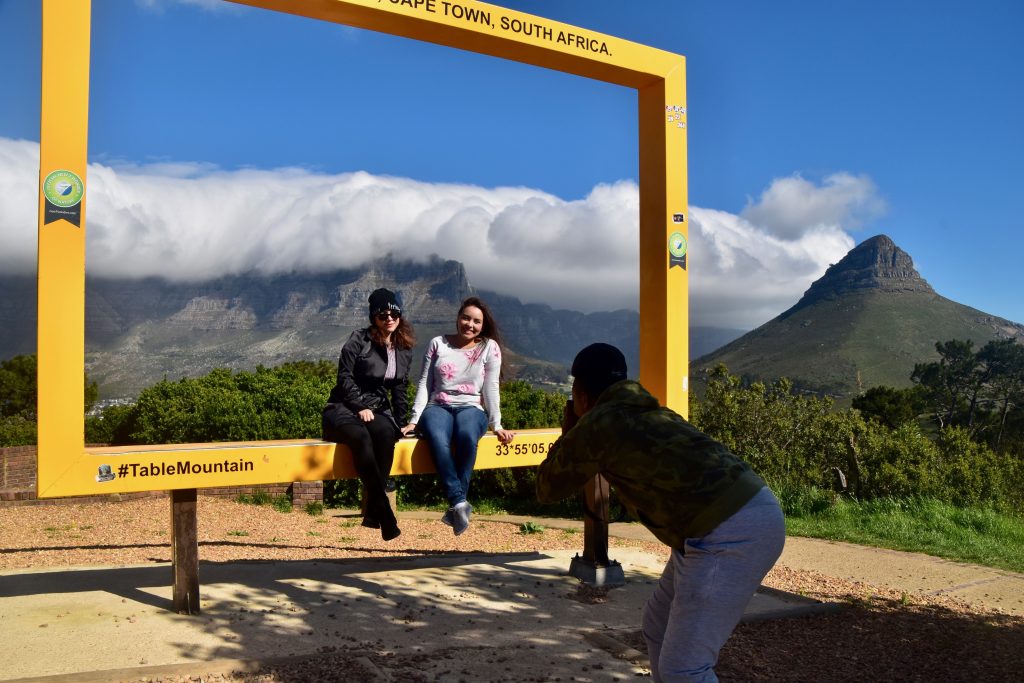
A great plus of the event was the host city, with its spectacular “Table Mountain”, one of the 7 natural wonders of the world, which day by day gave us a beautiful scenery, along with the imposing “Head of Lion”.
These series of lectures for us undergraduate students, were understandable, enlisted key concepts, and always summarised the objectives at the end in a brief conclusion. During the days of this Summit, we understood the reason of the motto “Using evidence, improving lives” and we were very inspired to follow this path. May this colloquium be the first of many, many more.

We thank Dr. Giordano Perez Gaxiola for the opportunity and the trust, and our University, the Autonomous University of Sinaloa, for the support.


The post Global Evidence Summit 2017 – a student perspective appeared first on Students 4 Best Evidence.

Tuesday, October 10, 2017

A thorough look into meta-analysis

This blog follows on from Ammar’s previous post “Meta-analysis: What, Why and How” (you will find the link to that blog at the bottom of this page, together with other handy resources).

A historical perspective

Meta-analysis is a type of research introduced in the 17th century in astronomy. The first clinical study to be published in this manner was published by the statistician Karl Pearson in the British Medical Journal (1).

The word “Meta-analysis” was first given to this specific model by the statistician Gene V. Glass (2). Some of his precious words were “my major interest currently is in what we have come to call …the meta-analysis of research. The term is a bit grand, but it is precise and apt … Meta-analysis refers to the analysis of analyses”.

What is the definition of meta-analysis?

Meta-analysis is a quantitative, rigorous, and precise type of research analysis. It intends to summarize and consolidate the results of an intervention in a specific cohort of people.

The value of using this statistical approach

The value of using Meta-analysis can be summarised in multiple points:

Firstly; it combines data from many studies – all studies available about a single specific topic – then gives a net effect estimate from all these studies. So, its sample size and power will be greater than any single study within the literature on this subject.

Secondly; we use Meta-analysis when there is a great degree of conflict between studies which can not be resolved without using meta-analysis. So, meta-analysis combines data from all these different studies and then gives us a precise result which can be easily understood.

Thirdly; it helps in establishing guidelines and straightening the clinical practice, as data from meta-analyses are derived from a wide scope of population so the meta-analysis will be more generalizable and powerful.

Level of evidence supplied by meta-analyses

Meta-analysis provides class I evidence according to the evidence pyramid. In this pyramid, meta-analysis of randomized controlled trials occupies the top part, the “apex of the pyramid”. After this comes systematic reviews, randomized controlled trials, cohort studies, case-control studies, case reports/ case series, then expert opinion which is not followed anymore in clinical sciences.

Pharmaceutical companies can depend on meta-analyses to gain approval of their drugs. In clinical practice, physicians use the meta-analysis approach for choosing the suitable course and effective doses for their patients. Also, researchers use this analytic approach to apply for grants to do research about what is called “gap of knowledge”, for example, to start testing a new regime.

How can we implement the steps of meta-analysis?

Firstly; we specify a topic for our project,

Secondly; we search relevant databases using keywords,

Thirdly; we screen the records retrieved from our search,

Fourthly; we extract data that can be analyzed (data available from two studies at least),

Fifthly; extracted data should be analyzed in software such as Review Manager or Stata,

Finally; retrieved data should be documented.


For further reading, please visit the websites below:

https://www.ncbi.nlm.nih.gov/pmc/articles/PMC3049418/

https://www.meta-analysis.com/pages/why_do.php

https://en.wikipedia.org/wiki/Meta-analysis

http://www.students4bestevidence.net/meta-analysis-what-why-and-how/

http://www.students4bestevidence.net/the-evidence-based-medicine-pyramid/

References:

1.   Pearson K. Report on Certain Enteric Fever Inoculation Statistics. Br Med J [Internet].            1904 [cited 2017 Jun 19];2(2288):1243–6. Available from: http://www.bmj.com/content/2/2288/1243

2.   Glass GV.  Primary, Secondary, and Meta-Analysis of Research. Educ Res [Internet].            1976 Nov 1 [cited 2017 Jun 19];5(10):3–8. Available from: http://journals.sagepub.com/doi/abs/10.3102/0013189X005010003

The post A thorough look into meta-analysis appeared first on Students 4 Best Evidence.

Before and After School Care for your Kid’s Future https://t.co/DMLvf3fvdB via @lileinsteins2

//platform.twitter.com/widgets.js
from Twitter https://twitter.com/lileinsteins2


Monday, October 9, 2017

Raising a Perfect Kid: Should Grandparents be involved?

In today’s world, we as parents strive hard to portray a perfect world for our kids: a world in which, we as super-parents consciously attempt to be the best. We get so involved in this race for perfection, that the ultimate truth never crosses our mind. The truth is: we are not perfect; our parents were not perfect; our child won’t be perfect, as nothing on this earth can be announced as perfect.

So how do we deal with this situation?  Maybe a change in perception could help. If we picture our child to be the one:  with instilled family values and, empathy; resilient, self-aware, and creative; known for the character: we might win this crazy race for perfection. Maybe not in the eyes of our peers but, definitely our own.

The stress of earning, taking care of family, and not to mention social life, takes a toll on us, and our parenting styles.  We subconsciously ignore our health and family relations. The fact, that it’s perfectly normal to ask for help with parenting, makes us feel repressed; especially if the one we need help from our grandparents.

However, not everyone is blessed with in-laws and, parents who are willing to help with the upbringing of their grandkids. But, if you are, then after a self-reality check, think about all the benefits grandparents-grandchildren relationship can bring in.

Financial Support

Daycare in U.S.A is more expensive than sending a child to college. Kathleen Elkins, who covers personal finances for Business Insider explains in her article “In 23 states, it costs more to send your child to daycare than college”  how educating a preschooler may be pricier than sending a teenager to college. The total cost of daycare varies based on the state you live in, a number of kids that require care, and their age. You can get accurate data based on the State you live in on the EPI ( Economic Policy Institute) website.

With an option of having grandparents babysit your child, just do the Math of how you could save money annually, for your child’s college and, retirement.

Family Values

Every family has certain traditional and, cultural values that are passed down from the previous generation. A promise made to family members, of being there for each other when needed.  Due to the fast-paced life that we live, honestly, how much time, do we spend explaining these values to our future generation. Maybe little, or none in some cases.

Grandparents are storytellers. They are an excellent source of information, and expertise, when it comes to varied life experiences. Research in neuroscience reiterates the fact that storytelling stimulates inner learning. Louis Cozolino, an American psychologist, and professor of psychology claims brain is a social organ, and stories are critical to brain development and learning (Cozolino, 2014).

Empathy

In today’s STEAM world, we as parents do our best to teach our kids about, Science, Technology, Engineering, Art, and Math. Talk about the classes we enroll them in so that they learn the basis of all the STEM careers, there are. In the midst of all this, we don’t have time to teach simple, yet important social-emotional skills. Skills like having empathy for others and, integrity takes back place in our lives.

Just being with grandparents, children develop and learn these skills. They learn how to converse confidently with older people.  A skill required to be successful in the workplace, a skill required to intellectually converse with professors, and mentors.

Responsibility

We all want to teach our kids the importance of being responsible. We set rules and boundaries for them. Sometimes these rules are fair, and sometimes, we just don’t have time to listen to our kids to help them understand. Here grandparents play a vital role. With the number of years of life experience under their belt, they easily portray a broader perspective to any situation.

Grandparents due to their undivided attention, gain kid’s trust faster than us. This trust and relationship teach children responsibility, which comes by taking care of each other.

Remember you are the parent, and you can control any situation. If you think grandparents can be bossy, then set rules right from the beginning. Help grandparents, help you by educating them and, connecting them to American Grandparents Association (AGA). Grandparents are a wonderful resource of knowledge and love. Let’s learn to give them credit, they deserve.

The post Raising a Perfect Kid: Should Grandparents be involved? appeared first on .

Wednesday, October 4, 2017

Earnest’s Next Chapter: Expanding Our Mission’s Impact

We are taking a major step forward to build out our business with the industry leader and can continue to realize Earnest’s mission.

The post Earnest’s Next Chapter: Expanding Our Mission’s Impact appeared first on Earnest Blog | Money Advice for Young Professionals.

Tuesday, October 3, 2017

Thoughts from the Global Evidence Summit

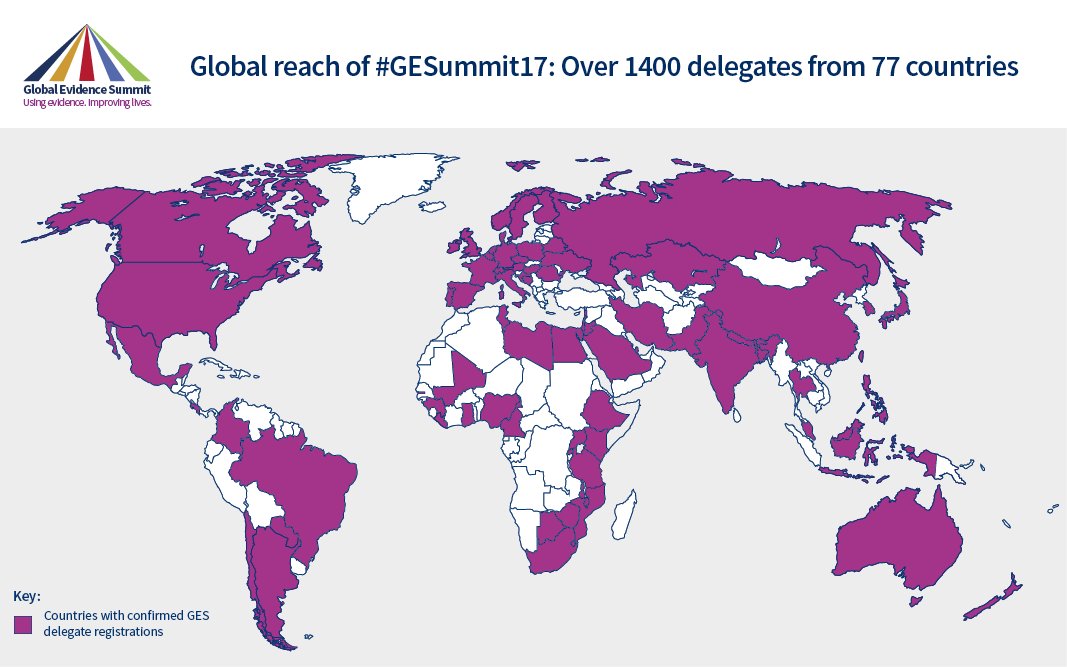
The Global Evidence Summit took place between 13th and 17th September 2017. The event saw over 1400 delegates from 77 countries gather in Cape Town, South Africa, to discuss how to use evidence to improve lives.

The Global Evidence Summit; a truly global event

The Global Evidence Summit was the first of its kind; a huge collaborative conference between 5 international organisations; Cochrane, The Campbell Collaboration, Guidelines-International Network, International Society for Evidence-based Health Care, and Joanna Briggs Institute.

The theme for the conference was ‘Using evidence. Improving lives‘, and broadly aimed to advance the use of trustworthy research evidence in addressing the health and social challenges we face around the world.


Why I was at The Global Evidence Summit

I’m a PhD student at the University of Aberdeen’s Health Services Research Unit, and my primary research interests lie in clinical trial efficiency – put simply, I want to know how we can make the process of designing, conducting and reporting clinical trials better. By better, I mean evidence-based. My PhD work focusses on the process of recruiting participants to trials, i.e. improving the production of primary research evidence, but I’m also interested in how we implement the evidence we have into trials more generally.

The Global Evidence Summit started out as one of those things I thought I’d ask my Supervisor about, thinking I’d get laughed out of his office. I’m in my final year of the PhD, and whilst I’ve been lucky enough to attend numerous conferences throughout the course of my studies, the cost of a conference trip to South Africa seemed like it would be a stretch.  A few months later and I had secured a short oral presentation, a poster presentation, and I’d agreed to co-chair one of the threaded sessions.

Pre-Summit nerves and some tips for students attending conferences

Before the conference I was feeling a bit nervous, but mostly excited – I was going to South Africa after all! In terms of travelling to Cape Town, my flight from Aberdeen to London was delayed, meaning I missed my connection to Cape Town and arrived at the Summit 26 hours later than planned. This was actually a really good thing in the end. Missing the first day of the conference wasn’t great. The delay did give me time to look through the programme and get my bearings a bit more, meaning that when I eventually landed I was raring to get started.

I downloaded the conference app and made sure I knew where I needed to be and at what time; that definitely settled my nerves. Conference apps are popping up more and more, and as someone who runs their life through iCal, this was very useful. Much easier than looking through a printed version and having to flick back and forth to see if talks clashed.

The conference itself

Ok, so the conference was really, really brilliant. I always come away from conferences feeling excited and motivated to get back to work, but this one was different. This was undoubtedly the biggest conference I’ve been to before, but it also had a very clear global vision. I learned so much that I hadn’t even thought about before, I spoke to people I’d never have met otherwise, and by the time I left I was feeling very hopeful for the coming years – both in terms of my own career, but our ability to include evidence in global health challenges too.

My highlights of the conference were two of the themed days. Each of the days was themed with a particular topic, starting with a plenary in the morning, and then leading on to a number of threaded sessions that allowed you to delve deeper into specific parts of the theme.

Thursday’s theme: BREAKING DOWN THE SILOS: Digital and trustworthy evidence ecosystem

Highlights: I’ve written an entire post over on my own blog on this, and the threaded session that I co-chaired (take a look here). This session in particular, motivated my own research ambitions. We need to be working in a cohesive evidence ecosystem, otherwise the work that we’re doing in our own little groups really won’t make the impact that it should. ‘Breaking Down the Silos’ was exactly what this session aimed to encourage. We heard from speakers with very different backgrounds, and listened to their own stories of how they had pushed for change in various sectors and research areas.

Speakers didn’t just focus on health – though that was the overarching focus of the conference. We heard from people involved in Education too, a sector that has had the luxury of starting an evidence ecosystem largely from the beginning. This insight gave me much food for thought; we can make the health evidence ecosystem so much better than it is currently. What’s missing so often is communication – talking to others outside of our field, to ensure that our work is spread and shared right through each of the stakeholders that may encounter its effects.

Saturday’s theme: EVIDENCE IN A POST-TRUTH WORLD: The evidence, ethos and pathos. How scientists can engage, and influence the public, press and politicians 


Highlights: Again, I’ve written a more in-depth post about this plenary (take a look here). This session connected with my broad research interests and thoughts. I am passionate about public engagement and involving the public in science as a whole, and it was refreshing to see a topic like this getting such a substantial platform. We heard from 3 brilliant speakers (and an all female panel!), who each covered topics related to evidence communication – whether that be to the public, the press or politicians. The public persona of science isn’t always brilliant. We often have to battle with poorly worded claims or false headlines, and it can be frustrating.

This session didn’t dwell on the problems of these cases though; sure, the fake MMR/autism link was mentioned, but it was presented in such a way that it evoked ambition and drive not to let this happen again. Once the plenary was finished, it really felt like the audience had been galvanized to do something – and it was a pretty unique feeling walking out of the auditorium feeling like I was part of a community of scientists that can, and will, change the way we tackle global health issues by using reliable evidence to improve lives.


Would I recommend attending future Global Evidence Summits?

If you haven’t guessed from my glowing review of this year’s Global Evidence Summit; YES. I really hope that this conference becomes an annual event, particularly because of the diversity of the audience. I was able to network with guideline producers, public health tacklers, researchers like myself, third sector representatives, even patients, from all corners of the world. This diverse audience, and therefore diverse line up of speakers, really strengthened the program, and ultimately made the conference a complete success for me. The Africancraft sellers and gumboot dancing did help make the whole thing pretty memorable too!

The post Thoughts from the Global Evidence Summit appeared first on Students 4 Best Evidence.